
What is IPTV? The Ultimate Beginner’s Guide for UK Viewers 2026
Last week, a mate in Manchester rang me up panicking. His satellite bill had crept past £95 a month, his kids wanted Korean dramas his package didn’t carry, and his father-in-law refused to watch anything that wasn’t live Premier League football. He’d heard the term “IPTV” thrown around in WhatsApp groups but hadn’t a clue what it actually meant. By the end of our conversation, he’d cancelled half his subscriptions and saved roughly £70 a month. That’s the kind of swing we’re seeing across UK households in 2026, and it’s exactly why this question — what is IPTV — keeps trending on Google search bars from Glasgow to Southampton.
This isn’t a recycled definition pulled from Wikipedia. It’s a working operator’s breakdown of what IPTV genuinely is, how it functions under the hood, why some services collapse within weeks while others run for years, and what UK viewers in 2026 need to know before paying a penny.
Breaking Down the Acronym Without the Jargon
IPTV stands for Internet Protocol Television. Strip the technical wrapper off and what you’re left with is television delivered through your broadband connection rather than through a satellite dish bolted to your roof or a coaxial cable threaded through your wall. Where traditional broadcast pushes a signal out to millions of homes simultaneously whether anyone is watching or not, IPTV sends specific channels and content to your screen only when you request them. The shift sounds small on paper. In practice, it changes everything about how households consume television.
When you ask what is IPTV, you’re really asking about a delivery method. The content itself — sports, news, films, kids’ programming, Arabic channels, Bollywood, Turkish drama — doesn’t change. What changes is the pipe carrying it to your living room.
Pro Tip: If anyone tries to sell you IPTV by talking about “satellite quality” or “cable replacement,” walk away. Real operators talk about server uptime, bitrate, and HLS latency. Salespeople talk about hype.
How the Technology Actually Moves Pictures to Your Screen
Most beginners imagine IPTV as a magical app that just finds channels somehow. The reality is far more mechanical. A broadcaster’s signal — whether it’s a sports match, a news bulletin, or a film — gets captured at a headend facility. From there, it’s encoded into a streaming format, typically HLS (HTTP Live Streaming) or MPEG-DASH, which slices the video into tiny chunks of a few seconds each. Those chunks travel across a content delivery network to edge servers positioned closer to viewers, then finally arrive at your device through your home internet connection.
The whole journey happens in roughly two to eight seconds, which is why live sports on IPTV often lags slightly behind a traditional satellite feed. That gap is called latency, and reducing it is one of the hardest engineering problems in the industry. Anyone claiming “zero latency” is either lying or doesn’t understand their own product.
Why Latency Matters More Than Most Buyers Realise
Picture this: you’re watching a Champions League quarter-final. Your neighbour, on a traditional broadcast, screams “GOAL!” through the wall before your screen even shows the build-up. That’s a six-second latency gap, and it ruins the experience. Premium IPTV operators invest heavily in low-latency HLS and fibre uplinks specifically to close that window. Cheap operators don’t, which is why their sports streams always feel a beat behind.
The Three Forms of IPTV You’ll Actually Encounter
When asking what is IPTV, it helps to know the format isn’t a single thing. Three distinct flavours exist, and most subscription services blend all three:
- Live IPTV — real-time channels mimicking traditional broadcast TV, including sports, news, and entertainment streams
- Video on Demand (VOD) — a library of films and series you watch whenever you want, similar to how Netflix or Prime structure their catalogues
- Time-Shifted IPTV — catch-up TV that lets you rewind a live channel or watch a programme that aired hours earlier
A serious IPTV provider in 2026 offers all three under one subscription. A weak one offers only live channels with no VOD backbone, which becomes painfully obvious the moment your household has multiple viewers with conflicting tastes.
Pro Tip: Before subscribing anywhere, ask whether the VOD library updates weekly. Static libraries are a red flag — it usually means the operator scraped content once and never invested in fresh ingestion pipelines.
What is IPTV Without Proper Infrastructure? Nothing.
Here’s the part most beginner guides skip entirely. The reason your cousin’s IPTV froze every Saturday afternoon during the football wasn’t bad luck. It was bad infrastructure. The service he subscribed to was probably running on a single overloaded server in some random data centre, with no load balancing, no backup uplink servers, and no failover plan. The moment 4,000 households hit the same Premier League stream at 3pm, the whole system buckled.
Real IPTV operations distribute load across multiple geographical points, maintain redundant uplinks, and use sophisticated panel credits systems to manage capacity. When you understand this, the question of what is IPTV expands beyond “TV through internet” into something more honest: it’s a streaming infrastructure business pretending to be a TV service.
The Cheap vs Premium Infrastructure Reality
| Factor | Cheap IPTV Setup | Premium IPTV Infrastructure |
|---|---|---|
| Server locations | Single data centre | Multi-region with edge nodes |
| Backup uplink servers | None | 2–3 redundant uplinks |
| Load balancing | Manual or absent | Automated, real-time |
| HLS latency | 10–15 seconds | 3–6 seconds |
| Concurrent stream capacity | Collapses past 1,000 users | Scales beyond 50,000 |
| Stream restoration after outage | Hours or never | Under 60 seconds |
| Buffer rate during peak hours | 15–30% | Under 2% |
The difference between these two columns is the difference between a service that survives three months and one that runs reliably for years.
Hardware and Apps: What You Actually Need at Home
You don’t need fancy equipment to use IPTV. A modern smart TV, an Amazon Fire Stick, an Android box, a Nvidia Shield, or even a laptop will do the job. The application running on that device matters far more than the device itself. UK viewers commonly use players like TiviMate, IPTV Smarters, Smart STB, or XCIPTV — each with different strengths around EPG accuracy, multi-screen support, and recording features.
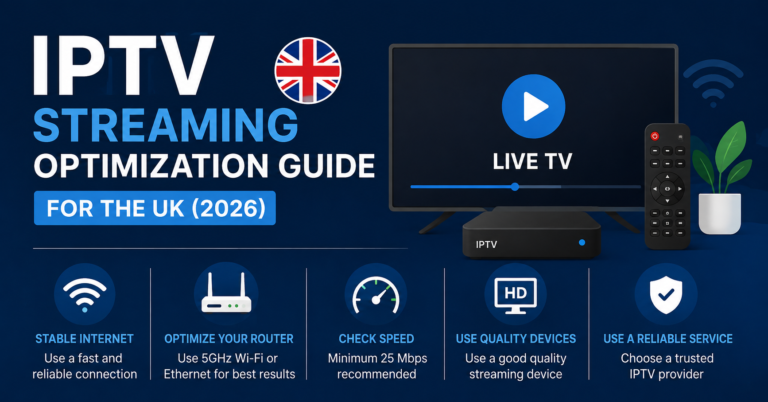
What is IPTV demanding from your home setup? Honestly, less than people fear. A stable broadband connection of 25 Mbps comfortably handles 4K streams. Most UK households on standard fibre packages already have more than enough bandwidth. The bigger issue is usually Wi-Fi placement, not raw speed. A £15 ethernet cable into your Fire Stick will solve more buffering problems than upgrading your broadband ever will.
Pro Tip: If your IPTV buffers only on certain channels, the problem is the operator’s server, not your internet. If it buffers on every channel, the problem is your network. Diagnose before you complain.
The Legality Question Nobody Wants to Answer Honestly
Let’s address this plainly because vague answers help no one. IPTV as a technology is completely legal. Major broadcasters, telecoms companies, and streaming giants all use IPTV protocols to deliver their services. What is IPTV in a legal sense? It’s a delivery method, no different from satellite or cable. The legality question only becomes complicated when you look at what content is being streamed and whether the operator holds proper licensing rights for that content in your region.
In 2026, UK enforcement against unlicensed streaming has intensified through AI-driven ISP blocking, DNS poisoning techniques, and increased coordination between rights holders and broadband providers. For end users, the practical risk depends heavily on which service they choose and how that service handles compliance.
What 2026 Enforcement Actually Looks Like
The landscape has shifted dramatically over the last 18 months:
- ISPs now deploy AI pattern recognition to identify streaming traffic signatures
- DNS-level blocking happens within minutes of a stream going live during high-profile matches
- Court orders against specific IPs are issued and enforced faster than ever
- VPN detection has improved on certain restricted services
This is precisely why infrastructure-grade providers invest in rotating endpoints, multiple uplinks, and rapid stream restoration protocols.
Why Resellers Sit at the Heart of the UK IPTV Market
A huge portion of the UK IPTV market doesn’t come from giant centralised companies. It runs through UK IPTV resellers — small operators, often working from home offices, who buy bulk panel credits from larger providers and sell subscriptions to end users in their communities. This decentralised model is why prices stay competitive and why customer service in IPTV can be either brilliant or catastrophic depending on which reseller you land with.
What is IPTV reselling, mechanically? A reseller purchases credits from a master panel, generates user lines for customers, manages renewals, handles billing, and provides front-line support. The good ones run proper businesses with documented processes. The bad ones disappear with your annual payment three weeks after taking it.
Pro Tip: Before paying any reseller, check how long their domain has been registered, whether they have any traceable customer reviews on independent platforms, and whether they offer monthly billing rather than demanding upfront annual payment. New domains plus annual-only billing is the classic exit-scam setup.
Pricing: What is IPTV Actually Worth in 2026?
The honest range for a quality UK IPTV subscription in 2026 sits between £8 and £20 per month, depending on connection count, VOD library size, and whether premium sports packages are included. Anything dramatically below £5 a month should make you cautious. Real infrastructure costs money — servers, bandwidth, content acquisition, panel licensing, support staff — and operators selling below cost are either burning investor money or running a short-term grab.
Compare that to a typical UK household stacking a satellite package, a sports add-on, two or three streaming services, and a film rental account. Many families are spending £130 to £180 monthly across that stack. A consolidated IPTV subscription can replace most of it for a fraction of the cost, which is why what is IPTV has become such a frequently searched phrase in cost-of-living-pressured households.
What Drives Real IPTV Pricing
Several factors shape what a sustainable IPTV operation must charge:
- Server and bandwidth costs scale linearly with subscriber count
- Premium sports streams require expensive ingestion infrastructure
- 24/7 support staff add significant overhead
- VOD library acquisition and updates are ongoing expenses
- Compliance, payment processing, and chargeback management eat into margins
When someone offers you 12 months of “10,000 channels” for £25, the maths simply doesn’t work for a legitimate operation.
Common Problems UK Subscribers Face (And What They Actually Mean)
Anyone asking what is IPTV will eventually hit one of these issues. Knowing what they signal helps you respond intelligently rather than blaming your provider for the wrong reason.
Buffering during peak hours: Almost always an infrastructure problem on the provider’s side. Their servers can’t handle concurrent load. No amount of router rebooting fixes this.
EPG (electronic programme guide) missing or wrong: Sloppy panel management. The operator hasn’t kept their guide data synchronised. Annoying but not technically broken.
Channels suddenly unavailable: Either ISP-level blocking has hit a specific stream, or the operator’s upstream source has been disrupted. Good operators restore within an hour. Weak ones leave it broken for days.
Login failures after recent purchase: Either credentials weren’t generated properly, or — worrying — the operator is preparing an exit. Always test login immediately after subscribing.
4K streams pixelating while HD runs fine: Your bandwidth is insufficient for 4K despite being adequate for HD. Downgrade your stream resolution before assuming the provider is at fault.
Pro Tip: Keep a backup IPTV subscription with a different provider during big sporting events. Even premium operators occasionally take hits during AI-driven blocking waves, and £8 of insurance beats missing a cup final.
Frequently Asked Questions
What is IPTV and how is it different from regular streaming services like Netflix?
IPTV delivers television content — including live channels, sports, and news — through internet protocol, while services like Netflix focus primarily on on-demand films and series. IPTV typically offers thousands of live channels including international content, sports, and regional programming that mainstream streamers don’t carry. The delivery technology is similar, but the content focus and live broadcasting capability set IPTV apart.
Is using IPTV legal for UK households in 2026?
IPTV as a technology is fully legal — major broadcasters use it themselves. Legality depends entirely on whether the specific service holds proper licensing for the content it delivers in the UK. Licensed IPTV from authorised providers is straightforwardly legal. Unlicensed services occupy a more complicated space, with risk falling primarily on operators rather than individual end users in most enforcement actions.
How much internet speed do I actually need for IPTV?
A stable 25 Mbps connection comfortably supports 4K IPTV streams, while 10–15 Mbps handles HD reliably. The bigger issue is connection stability rather than raw speed. Wired ethernet connections outperform Wi-Fi for streaming consistency. Most UK fibre packages already provide more than sufficient bandwidth — the bottleneck is usually router placement or wireless interference rather than your broadband tier.
What is IPTV reselling and can anyone start a reseller business?
IPTV reselling involves purchasing bulk panel credits from established providers and selling subscriptions to end customers. Technically anyone can start, but success requires understanding infrastructure quality, customer support workflows, billing systems, and panel management. Most new resellers fail within six months due to choosing unreliable upstream providers or underestimating support workload. Sustainable resellers treat it as a proper business with documented processes.
Can I watch IPTV on multiple devices in the same household simultaneously?
Most IPTV subscriptions specify a maximum concurrent connection count — commonly two to four streams at once. Premium packages allow more, while basic plans restrict to a single connection. If two family members try to stream simultaneously on a single-connection plan, the second login typically kicks the first off. Always check connection limits before subscribing if you have a busy household.
Why does my IPTV buffer during big football matches but not at other times?
Peak-hour buffering during major sports events almost always indicates inadequate server infrastructure on the provider’s side. When thousands of subscribers hit the same stream simultaneously, weak operators without proper load balancing collapse under demand. Premium services maintain backup uplink servers and distributed edge nodes specifically to handle these surges. Persistent peak-hour issues are a clear signal to switch providers.
What is IPTV without a stable provider — and how do I spot a reliable one?
A great IPTV experience depends almost entirely on the operator behind it. Reliable providers maintain redundant infrastructure, transparent contact details, established domain history, monthly billing options, and verifiable customer feedback. Warning signs include brand-new domains, demands for annual upfront payment only, suspiciously low pricing, no traceable reviews, and vague answers about server locations or support availability.
Do I need a VPN to use IPTV in the UK?
Whether a VPN is necessary depends on the service you’re using and your specific circumstances. Licensed IPTV from authorised UK providers doesn’t require VPN usage. Some users employ VPNs for privacy reasons or to access geo-restricted content. In 2026, certain services have improved VPN detection, which can complicate things. If your provider explicitly recommends a VPN, ask why before assuming it’s necessary.
Your Success Checklist for Choosing IPTV in 2026
If you’ve made it this far, you understand IPTV better than 95% of UK buyers. Now turn that understanding into action with these execution steps:
- Verify the provider’s domain age before paying anything — anything under 12 months old deserves extreme caution
- Test with a 24-hour or 48-hour trial rather than committing to annual billing on day one
- Run a peak-hour test during a busy sports evening to expose infrastructure weakness before you pay
- Confirm VOD library updates by asking when the catalogue was last refreshed
- Check concurrent connection limits against your actual household needs
- Wire your primary streaming device with ethernet rather than relying on Wi-Fi
- Document your provider’s support response time by sending a test query before subscribing
- Keep an emergency backup subscription with a second provider during major sporting events
- Avoid annual-only billing schemes from any service without years of verifiable track record
- Maintain realistic price expectations — sustainable IPTV costs £8–£20 monthly, not £25 yearly
Ready to try IPTV? Check out our premium UK IPTV subscription & UK IPTV Reseller plans today at britishreseller.com for infrastructure-grade streaming with proper backup uplinks, real support, and the kind of stability that survives big match nights.