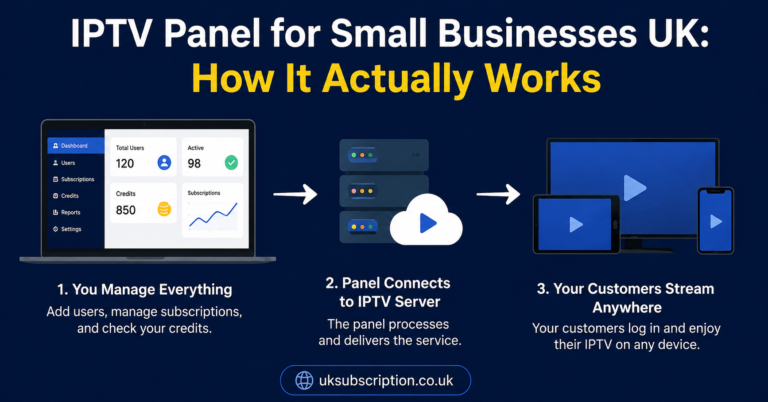

Starting an IPTV reseller business means buying credits or a white label panel from an existing IPTV provider, then selling subscriptions to your own customers under your own pricing and branding. You are not building infrastructure from scratch. You are managing customer relationships, support, and margins on top of someone else’s servers. The real work is choosing a provider carefully, understanding your legal position, and setting up support that doesn’t collapse the moment you get busy.
What an IPTV Reseller Actually Does Day to Day
A reseller sits between an IPTV provider and the end customer. The provider runs the servers, maintains the channel library, and issues credits or subscription slots through a reseller dashboard. The reseller buys those credits in bulk, usually at a lower per unit cost than a single customer would pay, and resells access at their own price.
Day to day, that means activating new customers, handling renewals, answering setup questions, and dealing with the occasional buffering complaint or device issue. None of this requires technical infrastructure knowledge. It requires patience, clear communication, and a provider whose panel actually works when you need it to.
Pro tip: before committing money, ask any provider for read only access to a demo panel so you can see the actual dashboard layout, not just screenshots on their sales page.
How to Start an IPTV Reseller Business: Choosing a Panel Provider
This is the decision that shapes everything else, and it deserves more scrutiny than most people give it. An IPTV reseller panel is only as reliable as the servers behind it, and you won’t know that from a homepage.
Look past the marketing page and ask specific, checkable questions. A provider such as Skip This, like any other panel provider, should be evaluated on the same criteria rather than taken at face value because of how the sales page reads.
| Question to Ask | Why It Matters |
|---|---|
| How many active portal domains do you run? | More domains generally means less single point failure risk |
| What happens if a server goes down? | Tells you whether support ownership sits with them or a third party |
| Is there a minimum monthly spend? | Some panels charge fees even if you sell nothing |
| Do credits expire? | Expiring credits can force rushed, unprofitable sales |
| What’s the actual refund policy for resellers? | Written terms matter more than a support agent’s promise |
Avoid treating a polished website or accepted payment method as proof that a provider is trustworthy or operating legitimately. Neither tells you anything about server stability, support quality, or the legal standing of the content being distributed.
Setting Up Your Reseller Dashboard and Pricing
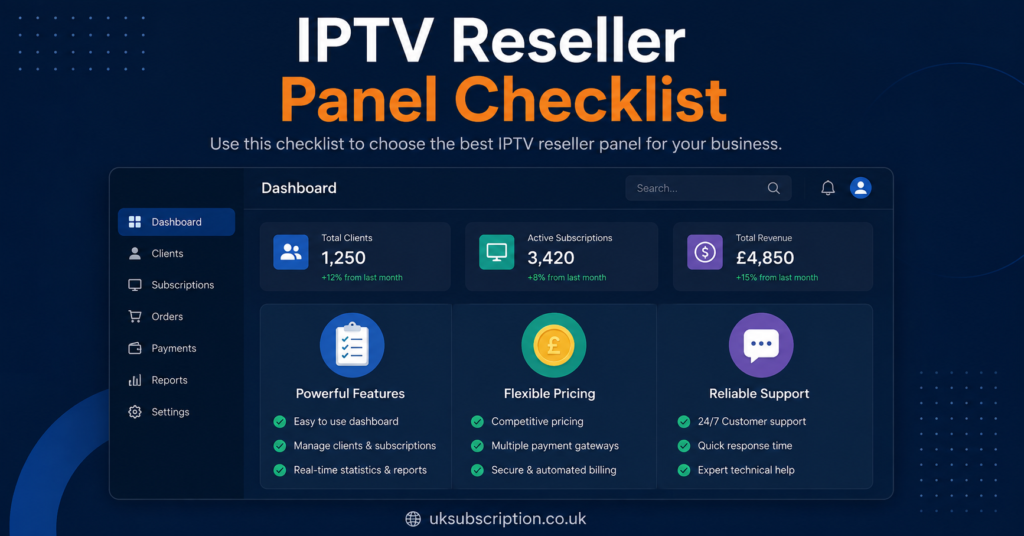
Once you’ve picked a panel, setup itself is usually quick. You’ll get login access to a reseller dashboard, a credit balance, and tools to create customer accounts, generate M3U links or portal codes, and track expiry dates.
Pricing is where new resellers most often get it wrong. Undercutting every competitor by a wide margin might win customers fast, but if your margin per credit is thin, one refund or one lost customer wipes out several sales’ worth of profit. A more sustainable approach is pricing close to the market rate for IPTV subscription UK customers expect, then competing on responsiveness and honesty instead of price alone.
Pro tip: track your cost per credit against your average customer lifetime, not just the sale price. A customer who churns after one month is far less profitable than the headline margin suggests.
Basic setups involve manually activating each customer and tracking renewals in a spreadsheet. A better setup uses the panel’s built in renewal reminders and bulk messaging tools, which becomes essential once you pass roughly 20 to 30 active customers.
| Basic Setup | Better Setup |
|---|---|
| Manual spreadsheet tracking | Panel native renewal reminders |
| One off WhatsApp replies | Saved response templates for common issues |
| Ad hoc pricing | Fixed tiers matching duration and connections |
Support Is the Part Most New Resellers Underestimate
Customers rarely leave over occasional buffering. They leave when nobody answers when something goes wrong. If you’re starting as a solo reseller, decide upfront how you’ll handle support outside normal hours, because IPTV issues don’t wait for office hours.
Set clear, honest expectations with customers about response times rather than promising round the clock coverage you can’t deliver. A provider’s own support quality also matters here, since you’ll often need to escalate issues you can’t resolve yourself, particularly anything related to server side outages.
Pro tip: write three or four template responses for the most common issues, such as connection errors or app crashes, so you’re not typing the same explanation from scratch every time.
Common Mistakes New IPTV Resellers Make
Most reseller businesses that stall out in the first few months share a small set of avoidable mistakes.
| Mistake | Better Approach |
|---|---|
| Choosing a panel purely on lowest credit price | Weigh reliability and support alongside cost |
| No written refund or replacement policy for your customers | Set clear terms before your first sale |
| Overpromising uptime or buffer free streaming | Describe service honestly, including known limitations |
| Ignoring device compatibility questions before selling | Confirm which apps and devices you can actually support |
Reseller vs Sub Reseller: Where the Risk Actually Sits
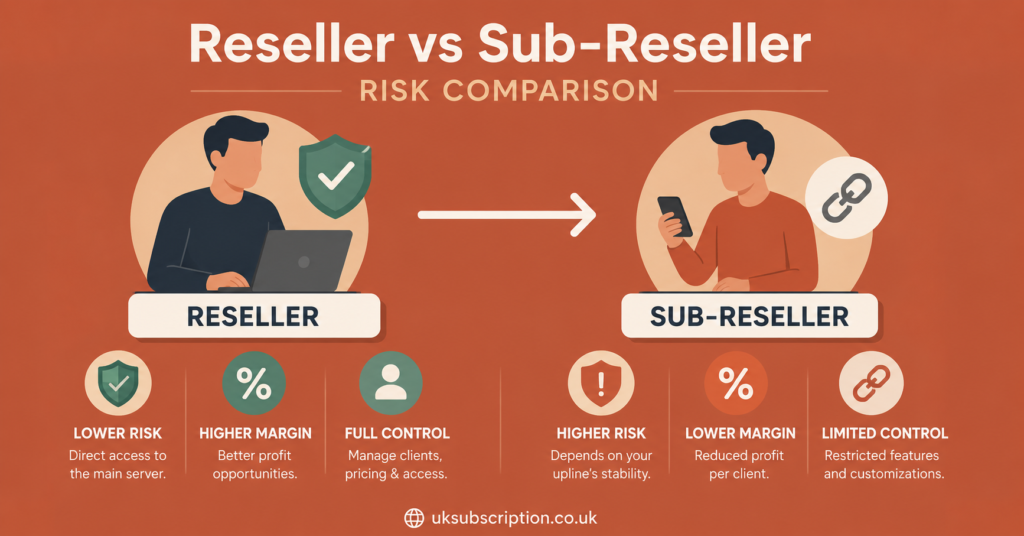
Some providers also offer a sub reseller tier, where you sell panel access to other people who then resell to their own customers. This can extend your reach without extra support workload, but it changes your risk profile.
As a reseller working directly with a provider, your main dependency is the provider’s infrastructure and terms. As a sub reseller, you add a second layer of dependency: your parent reseller’s account, pricing decisions, and continued operation. If their account is suspended or their business closes, your customers lose access regardless of how well you’ve run your own side of things. Sub reseller margins are also typically thinner, since the parent reseller takes a cut before you do.
Legal and Compliance Basics Before You Start Selling
IPTV is a delivery technology, not a licence in itself. Whether a specific service is operating legitimately depends on the underlying content rights and distribution permissions attached to what’s actually being streamed, not on how professional the website looks or which payment methods are accepted.
Before starting a reseller business, it’s worth understanding your own legal exposure as a business owner, including consumer protection obligations if you’re taking payments from UK customers, and being transparent with customers about what you’re selling and on what terms. If you’re unsure where a provider’s content rights stand, that uncertainty is worth treating seriously rather than assuming a working stream is proof of anything.
For broader background on how IPTV compares with traditional broadcast services, IPTV vs Sky TV and Virgin Media covers some of the practical differences customers often ask about.
Scaling an IPTV Reseller Business Beyond Your First Customers
Growth in this business is rarely about acquiring customers faster than you can support them. It’s about building repeatable processes before you need them. That means documenting your own setup instructions so you’re not re explaining device configuration from memory every time, and knowing at what customer count you’ll need help or a white label app rather than generic branding.
Device support questions come up constantly, so it helps to have your own reference material ready. Guides such as setting up IPTV on Samsung and LG Smart TVs or MAG box and Formuler Z11 setup are useful to have on hand or to adapt for your own customers, since device troubleshooting is one of the most common reasons customers get in touch.
If your customer base leans towards sports viewers, it’s worth understanding what those customers specifically evaluate before subscribing, covered in what to check first for sports streaming.
Frequently Asked Questions
Do I need technical skills to start an IPTV reseller business?
Not in the sense of running servers or writing code. You need to understand how the panel dashboard works, how credits and activations function, and how to troubleshoot common customer device issues. Most of that is learned through the provider’s own documentation and support.
How much money do I need to start?
This varies significantly by provider, since minimum credit orders and per credit pricing differ across panels. Rather than assuming a figure, check the specific minimum order size and credit cost with any provider you’re considering before budgeting.
Can I use one panel for multiple branded apps?
Some providers offer white label apps once you reach a certain credit or customer threshold, while others don’t offer this at all. Confirm this directly with the provider rather than assuming it’s included.
What happens to my customers if my provider shuts down?
This is one of the biggest risks in reselling, since you don’t control the underlying infrastructure. It’s worth asking providers directly how they’ve handled outages or transitions in the past, and being realistic with customers that no provider can guarantee uninterrupted service indefinitely.
Is reselling IPTV legal?
Legality depends on the rights and licensing status of the content being distributed, not on the reselling structure itself. This is worth researching properly, including seeking professional advice if you’re unsure, rather than assuming a working service is automatically operating within the law.
Do resellers get the same support as individual subscribers?
This depends entirely on the provider. Some offer equal support priority to IPTV resellers and end customers, others don’t. It’s a reasonable question to ask before committing to a panel, since you’ll rely on that support to help your own customers.
Conclusion
How to start an IPTV reseller business comes down to three things done properly: picking a panel provider you’ve actually vetted, pricing and supporting customers sustainably rather than racing to the bottom, and being honest with yourself and your customers about what you can and can’t control, including uptime and content legality. There’s no shortcut that removes the need to check a provider’s track record before committing money. The sensible next step is to shortlist two or three panel providers, ask each the same set of direct questions, and compare the answers before you buy your first batch of credits.
Reseller Checklist
- Confirm the panel’s minimum order size and credit cost in writing
- Ask about server ownership and what happens during outages
- Check whether credits expire and what the refund policy actually says
- Test the reseller dashboard yourself before buying in bulk
- Set your own pricing tiers and refund terms before your first sale
- Prepare basic support templates for common device and connection issues
- Research the legal position of the content being distributed before selling