
Let me fetch from the target domain to pull accurate internal links.I have the internal link targets. Here is the full article.
SEO Title Options
- United Kingdom IPTV Explained: How It Works and What to Know in 2026
- United Kingdom IPTV in 2026: A Plain Guide for Viewers and Resellers
- What Is United Kingdom IPTV? Setup, Devices, and Costs for 2026
Meta Description
A clear, no-jargon guide to United Kingdom IPTV in 2026. Learn how it works, what devices it runs on, what to check before you buy, and how reselling works.
United Kingdom IPTV Explained: How It Works and What to Know in 2026
United Kingdom IPTV is television delivered over your internet connection instead of through an aerial, satellite dish, or cable line. Rather than a signal coming down from a transmitter, the content travels to your screen as data, the same way a video on a website loads. You connect an app on a Firestick, smart TV, phone, or computer to a provider’s server, and that server streams live channels and on-demand titles straight to you. That is the whole idea in one sentence: TV that arrives through your broadband rather than a dish on the roof.
What United Kingdom IPTV Actually Means in Plain Words
The letters stand for Internet Protocol Television. Internet Protocol is just the rulebook your devices already use to send data across the web, so IPTV is television that follows those same rules. Nothing exotic is happening. When you stream a film on any normal video app, you are already using the same underlying technology. United Kingdom IPTV simply applies that delivery method to live channels and large libraries of stored content, then bundles it into one app and one login. The reason people treat it as a separate category is the scale and the live element, not the technology itself.
Why People in the UK Are Moving Toward This
Traditional setups tie you to one physical line and one box in one room. Streaming over the internet removes that limit. You can watch on a TV in the lounge, then pick up the same subscription on a tablet in the kitchen. For households that have already cut the cord and rely on broadband for everything else, adding TV to that same pipe feels natural. Cost is the other driver. A single internet-delivered service often gathers content that would otherwise need several separate subscriptions, which is why curiosity about it keeps growing year on year.
How United Kingdom IPTV Delivers a Stream to Your Screen
Behind the scenes, the provider runs servers that hold or relay the content. When you open the app and select a channel, your device asks the server for that stream, and the server sends it back in small chunks your player stitches together in real time. Most modern services use a method called HLS, which breaks video into short segments so playback stays smooth even when your connection wobbles slightly. If a segment is slow to arrive, the player has a small buffer to cover the gap. This chunked approach is the reason a good stream recovers quickly instead of freezing for a minute.
The Infrastructure That Sits Behind a Provider
A serious operator does not run everything off one machine. They spread load across several servers in different locations so that if one is busy or down, another picks up the demand. They attach many portal domains to that infrastructure, which is partly a redundancy measure and partly a way to keep service reachable. The provider behind uksubscription.co.uk describes running its own private servers with thousands of portal domains, which is the kind of setup that separates a direct operator from someone simply passing along another company’s feed. When you understand this layer, you understand why two services at the same price can feel completely different in practice.
Pro Tip
When comparing any United Kingdom IPTV service, ask one direct question: do you own your servers, or are you reselling someone else’s feed? The answer tells you who fixes things when a stream breaks. A direct operator solves it in-house. A reseller has to wait on a supplier upstream, and that wait is your buffering.
What Internet Speed United Kingdom IPTV Needs
You do not need a fibre connection to enjoy this, but you do need stability more than raw speed. A standard high definition stream runs comfortably on a steady connection in the mid single digits of megabits per second, while 4K content asks for noticeably more headroom. The mistake people make is chasing a huge speed number while ignoring consistency. A connection that holds 30 Mbps steadily beats one that spikes to 100 then drops to 10. If you want the detailed numbers per quality level, the breakdown in this UK IPTV speed guide lays out exactly what each resolution demands so you can match a plan to your broadband honestly.
Devices That Run United Kingdom IPTV Without Fuss
The good news is that almost any screen you already own will work. The Amazon Firestick is the most common choice in British homes because it is cheap, small, and easy to set up. Smart TVs from the major brands handle it through their own app stores or by sideloading. Windows computers run dedicated players that let you sort channels properly. Android boxes and phones are well supported, and Apple devices work through compatible players with a few extra setup steps. The table below sums up where each device sits.
| Device Type | Setup Difficulty | Notes |
|---|---|---|
| Firestick / Fire TV | Easy | Most popular UK choice, ready in minutes |
| Smart TV (LG, Samsung) | Easy to Moderate | App store install or sideload by model |
| Windows PC | Moderate | Best for sorting large channel lists |
| Android Box / Phone | Easy | Wide player compatibility |
| iOS / Apple | Moderate | Works through compatible players |
Choosing a Player App for United Kingdom IPTV
The app you load matters more than people expect. A poor player makes a good service feel broken, with messy channel lists and frequent crashes, while a stable player makes the same service feel premium. Many providers build their own apps tuned to their portal system, and these usually behave better than generic ones because they are designed for that specific infrastructure. On the third-party side, a couple of well-known Android players have earned trust through years of stable performance. If you are setting up on a Firestick specifically, this rundown of the best IPTV players for Firestick saves you the trial and error of installing the wrong one first.
The Single Most Common Setup Mistake
Almost every connection failure on a first attempt comes down to one tiny detail. People type the server address with https when the portal actually runs on plain http. That extra letter, added out of habit, produces an instant connection error and convinces a new user the whole service is broken when it is working perfectly. Removing the s and reconnecting fixes it in seconds. It sounds trivial, but it stops more people on day one than any genuine technical fault, which is why any decent provider mentions it before you even ask.
Pro Tip
Before you blame the service for a connection error, check three things in order: the http versus https detail, your portal address for a typo, and whether your internet is actually up. Nine times out of ten the problem is in that list, and a two-minute message to support clears the last one.
Understanding the Legal Grey Area Honestly
This is the part most marketing pages skip, so let us be straight about it. The technology of United Kingdom IPTV is completely legitimate. Plenty of broadcasters and official platforms deliver their own content over the internet using exactly this method. Where it gets murky is content rights. A service is only as legal as its licensing, and some operators stream channels or events they do not hold the rights to. As a viewer, you are responsible for choosing services that respect those rights, and as a reseller you carry even more of that responsibility. The sensible position is to favour providers transparent about what they license and to use official broadcaster routes for anything in a tightly protected window.
Where to Watch Big Events the Proper Way
When a major match or premiere is coming up, the cleanest route is almost always the official broadcaster or the licensed streaming platform that holds the rights for that event in the UK. These services exist precisely to deliver that content legally, often with the highest quality feed available because they are the source. A genuine “where to watch” approach means checking which official platform holds the rights and going there directly. It removes legal worry, it usually gives you the most reliable stream, and it supports the people who actually made or secured the content. That honesty is worth more than any shortcut.
What a Subscription Typically Includes
Most United Kingdom IPTV subscriptions bundle a large live channel count with an even larger on-demand library, sorted by category so you can actually find things. Quality tiers usually run from standard HD up to genuine 4K where the source supports it, and good services are careful to label real 4K rather than upscaled HD wearing a 4K badge. Subscription lengths commonly span one month up to a year, with longer terms costing less per month. Plans, durations, and current pricing sit on the provider’s own IPTV subscription plans page, which is the right place to check live figures rather than trusting numbers in any third-party article.
How United Kingdom IPTV Reselling Works
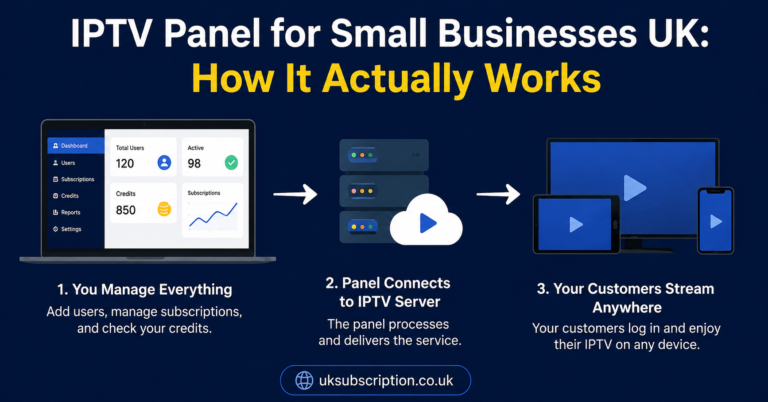
Beyond watching, there is a whole business layer. Reselling means buying capacity from a provider in bulk, then selling subscriptions to your own customers under your own brand. Providers usually run this on a credit system, where one credit equals one month of service for one customer. You buy a block of credits, set your own retail prices, and keep the margin. The appeal is that you handle sales and support for your customers while the provider handles the servers. It is a real small business model, and the better panels charge no recurring monthly fee, only the credits you actually use.
The Credit Economics Resellers Should Understand
The maths is simpler than it looks. You pay a wholesale rate per credit, often lower as you buy larger blocks, and you sell each subscription at retail. Your profit is the gap, minus the time you spend on support. The smart resellers do not compete purely on being cheapest, because that race ends with thin margins and demanding customers. They compete on reliability and fast replies, which lets them charge a fair price and keep customers for longer. Churn, meaning customers who leave, is the silent killer of reseller profit, so retention matters far more than a flashy launch discount.
Pro Tip
If you are starting as a reseller, treat your first thirty customers as a test, not a payday. Watch which ones renew and why. The patterns you spot in that first batch, what they ask, what breaks, what keeps them, will shape a far more profitable second hundred than any pricing trick.
Sub-Reselling and the Tier Below
There is one more layer worth knowing. A sub-reseller buys credits from a reseller rather than directly from the provider, then sells to their own circle. It lets someone start very small without committing to a large upfront order. For the reseller above them, it is a way to move volume and build a small network. The trade-off is that each layer adds a little cost and a little distance from the source, so sub-resellers should pick the reseller above them as carefully as a customer picks a provider. Clear communication up the chain is what keeps the whole structure stable.
United Kingdom IPTV Compared With Traditional TV
It helps to see the two side by side rather than in the abstract. Traditional television gives you a fixed, regulated, rock-solid signal but ties you to hardware and location. Internet-delivered television gives you flexibility and breadth at the cost of depending on your broadband quality. Neither is simply better. The right choice depends on how you watch and how good your connection is.
| Factor | Traditional TV | United Kingdom IPTV |
|---|---|---|
| Delivery | Aerial, dish, or cable | Your internet connection |
| Flexibility | Fixed to one box | Any connected device |
| Depends On | Signal hardware | Broadband stability |
What to Check Before You Buy Any Service
Before handing over money, run a short mental checklist. Does the provider offer a free trial so you can test the real thing rather than a demo? How fast does support actually reply when you message them? Are they a direct operator or a reseller several layers deep? Is their pricing the final figure or will setup and renewal surprises appear later? A trustworthy service answers all four comfortably. Many newer operators in this space vanish within a year or two, so longevity and a registered company behind the service are genuinely reassuring signals, not just marketing decoration.
Conclusion
United Kingdom IPTV is, at its core, simply television delivered over your broadband instead of a dish or cable, and once you strip away the jargon it stops feeling intimidating. The technology is legitimate and the same one official platforms use every day. What separates a good experience from a frustrating one is rarely the concept and almost always the operator behind it, whether they own their servers, how fast they reply, and how honest they are about pricing and content rights. Whether you are a viewer wanting flexible TV, a reseller building a small business, or a sub-reseller starting tiny, the same principle holds. Choose United Kingdom IPTV providers who are transparent, who respect content licensing, and who treat support as a standard rather than an afterthought, and the rest tends to take care of itself.
Execution Checklists
Subscriber Checklist
- Test your broadband stability, not just its peak speed.
- Ask for a genuine free trial before paying anything.
- Confirm your device is supported and pick the right player app.
- Remember the http versus https detail to avoid the day-one error.
- Check that the quoted price is final, with no setup or renewal surprises.
- Favour services transparent about what content they license.
Reseller Checklist
- Confirm the credit system, especially whether credits expire.
- Check there is no recurring monthly fee beyond credits used.
- Test the provider’s support speed as your customers will experience it.
- Start with a small credit block and treat it as market research.
- Set retail prices on reliability, not on being the cheapest.
- Track renewals and churn from your very first customers.
Sub-Reseller Checklist
- Vet the reseller above you as carefully as a customer vets a provider.
- Start with the smallest viable credit order to limit early risk.
- Confirm how quickly the tier above you responds when issues arise.
- Keep communication clear up the chain so problems get fixed fast.
- Understand that each layer adds cost, so price with that in mind.
- Build a small, loyal circle before chasing volume.
FAQ
Is United Kingdom IPTV legal? The technology is fully legal and the same method official platforms use. Legality depends entirely on content licensing. Services that stream properly licensed content are legitimate, while those streaming unlicensed channels or events are not. As a user, choosing transparent providers and official routes for protected content keeps you on the right side.
What internet speed do I need? Stability matters more than raw speed. Standard HD runs on a steady mid-single-digit megabit connection, while 4K needs more headroom. A consistent connection beats a fast but unstable one every time.
Which device is best for beginners? The Amazon Firestick is the most popular starting point in UK homes because it is affordable, simple to set up, and ready within minutes of installing the right player app.
Why do I keep getting a connection error? The most common cause is typing https instead of http in the portal address. Removing that single letter and reconnecting fixes it in most cases.
What is the difference between a reseller and a sub-reseller? A reseller buys credits directly from the provider and sells to customers. A sub-reseller buys from a reseller instead, allowing a smaller start at slightly higher cost and one more step from the source.