

Start Your Own IPTV Business in the UK: What the Guides Won’t Tell You
I’ll start with a number that surprises most people who message me asking how to start their own IPTV business in the UK: roughly seven out of ten new resellers I’ve watched enter this market quietly disappear within their first four months. Not because the demand isn’t there — it absolutely is. They vanish because they treated a reselling operation like a side hobby, bought the cheapest panel they could find, and discovered too late that they’d built their entire income on top of someone else’s collapsing infrastructure.
I’ve spent the better part of a decade inside this industry — managing panels, watching servers buckle during Champions League nights, refunding angry customers at 2am, and rebuilding UK IPTV reseller setups after a supplier went dark without warning. So this isn’t a motivational “anyone can do it” piece. It’s closer to a field manual. If you want to start your own IPTV business in the UK and still be running it next year, the details below are the ones that actually decide whether you survive.
Before Anything Else: Understand What You’re Actually Selling
Here’s a misconception I correct constantly. New resellers think they’re selling channels. They’re not. Channels are a commodity — every panel on the planet offers the same football, the same movies, the same sports.
What you’re really selling is uptime and response time. A customer doesn’t renew because you had 45,000 channels instead of 40,000. They renew because the stream didn’t freeze during the match, and because when something broke, a human answered them within minutes instead of hours.
Once that clicks, every other decision — which supplier, what pricing, how much to reinvest — starts making sense. You stop competing on channel counts and start competing on reliability, which is the only thing customers actually pay repeatedly for.
Pro Tip: Track your own response time as a hard metric from day one. The resellers who survive long-term almost always reply in under five minutes during peak hours. It feels excessive early on, when you have twelve customers. It becomes your entire competitive moat when you have four hundred.
The Supplier Decision That Makes or Breaks You
Everything downstream depends on who sits above you in the supply chain. This is where most new operators make their first fatal error: they pick the cheapest credit price and assume all panels are equal.
They are not. The IPTV market is layered — and you need to know which layer you’re buying from.
| Supplier Type | What You’re Actually Getting | Risk Level |
|---|---|---|
| Direct provider (owns servers) | Source infrastructure, accountable support | Lowest |
| First-tier reseller | One layer removed, usually stable | Moderate |
| Reseller of a reseller | Multiple hidden layers, slow fault resolution | High |
| “Cheapest panel online” | Unknown source, frequent disappearances | Severe |
The closer you buy to the actual infrastructure owner, the fewer people sit between you and a fix when something breaks. A provider like uksubscription.co.uk, for example, operates on a direct-provider model — owning the servers and portal domains rather than routing through unknown upstream hands. That structure matters more than the per-credit price, because when a stream dies during a Saturday fixture, you do not want to be three phone calls away from anyone who can fix it.
When you’re evaluating where to source your panel to start your own IPTV business in the UK, the question isn’t “how cheap are the credits.” It’s “when a server goes down, how many people are between me and the person who can restart it?”
Why Cheap Infrastructure Costs You More
Let me walk through a real pattern I’ve seen repeat dozens of times.
A new reseller finds a panel offering credits at half the going rate. Brilliant margins, they think. They onboard fifty customers in a month. Then a major sports event hits, the underpowered server can’t handle concurrent load, and every single one of those fifty customers experiences buffering at the worst possible moment.
Here’s the maths nobody runs beforehand:
- Acquiring those 50 customers cost real time and money
- A bad streaming night triggers refund demands from maybe 15 of them
- Another 20 silently don’t renew next month
- Your “cheap” panel just cost you 70% of a customer base you worked weeks to build
Cheap infrastructure isn’t cheap. It’s deferred churn. You pay for it later, with interest, in lost renewals and a damaged reputation that follows you across every WhatsApp group where customers compare providers.
The Pricing Psychology Most Resellers Get Backwards
New operators almost always price too low. The logic feels sound — undercut everyone, win on price. In practice, rock-bottom pricing attracts the worst possible customer: the one who churns constantly, demands the most support, and leaves the moment someone offers a pound less.
I learned this watching one reseller obsess over being the cheapest option in his local market. He won the price war and lost the business. His margins were so thin that a single refund wiped out the profit from ten subscriptions, and the bargain-hunters he attracted never renewed.
Pro Tip: Price slightly above the desperate bottom of the market, and pour the difference into support quality. Customers who pay a fair price complain less, churn less, and refer more. The cheapest customer is almost always the most expensive one to keep.
A practical mid-market structure that works in the UK looks roughly like a low monthly entry price, with the real value built into longer 6 and 12-month plans where your margin and customer stability both improve.
Understanding Churn Before It Eats You
Churn is the silent killer of every IPTV business in the UK. You can be adding customers every week and still shrinking if the back door is wider than the front.
After reviewing hundreds of support requests over the years, I can tell you most cancellations trace back to three causes, in this order:
- A bad streaming experience during a high-stakes moment — usually a live match
- Slow or absent support when the customer hit a problem
- A confusing setup that left them frustrated before they ever got watching
Notice what’s missing from that list: price. People rarely leave a service that works reliably over a few pounds. They leave services that fail them when it matters.
This is why infrastructure and support aren’t “nice to have” — they’re the entire retention engine. Fix those, and churn drops to a level where growth actually compounds instead of leaking away.
Devices and Setup: Where New Customers Get Lost
A surprising amount of early churn happens before the customer even watches anything. They subscribe, try to set up, hit a wall, get no help, and request a refund within the hour.
In the UK, the device landscape is fairly predictable:
- Amazon Firestick — by far the most common; expect the majority of your customers here
- LG and Samsung Smart TVs — large segment, app-store or sideload setup
- Android boxes and Android TV — players like TiviMate are popular
- Windows PC and iOS — smaller but consistent
- MAG boxes — a shrinking minority, under 5% in most customer bases
A setup checklist worth handing every new customer:
- Confirm their device type before they pay
- Send the correct app and portal details proactively
- Flag the single most common error: using
http://nothttps://in the portal address - Stay available on chat through their first successful playback
That last point matters more than it sounds. The customer who gets to a working stream on day one with a human guiding them becomes a long-term renewal. The one who struggles alone becomes a refund.
The Technical Realities You Can’t Ignore
You don’t need to be a network engineer to start your own IPTV business in the UK, but you do need to understand a few concepts well enough to ask your supplier the right questions — and to spot when they’re feeding you nonsense.
Load balancing spreads viewers across multiple servers so no single machine collapses under a big match. Ask your supplier directly whether they balance load during peak events. A vague answer is a red flag.
Failover and backup uplinks mean that if one server or connection drops, traffic reroutes automatically instead of leaving every customer staring at a frozen screen. Providers serious about uptime build redundancy in; cut-price panels skip it to save money.
DNS routing is how customer apps find the right server. Poorly managed DNS — or DNS poisoning, where requests get maliciously redirected — is behind a lot of mysterious “it stopped working overnight” complaints.
Pro Tip: When ISPs in the UK tighten up around major sporting events, you’ll sometimes see unusual throttling or connection issues cluster on specific nights. Experienced providers monitor for this and rotate routing accordingly. If your supplier has never heard of it happening, they either aren’t watching closely or aren’t big enough to notice the pattern.
Support Operations: The Part Everyone Underestimates
When you have ten customers, support is trivial. When you have three hundred, it’s the entire job. The resellers who scale successfully build their support approach early, before volume forces a panicked scramble.
A few things I’ve learned running support at volume:
- Most tickets are the same five issues — write yourself quick templates, but never send them coldly
- Speed beats polish; a fast “let me check that right now” outperforms a perfect reply two hours later
- Reseller customers (sub-resellers) need the same response speed as end users, not a slower second-tier queue
The providers worth partnering with extend fast support to their resellers too. When you source from an operation that treats partner support seriously — the kind of two-minute response model that britishseller.co.uk built its reputation on — you inherit that reliability and pass it straight to your own customers. Your support quality can only ever be as good as your supplier’s.
A Mini Case Study: Two Resellers, One Lesson
Two people started reselling around the same time. Same market, similar starting budget.
The first chased the lowest credit price he could find, marketed aggressively on price, and grew fast — to about 200 customers in three months. Then his cheap panel buckled during a major fixture, refunds poured in, and he was effectively out of business by month five.
The second started slower. She paid a little more for a stable, direct-sourced panel, replied to every message within minutes, and grew to maybe 80 customers in the same period. But almost all of them renewed. A year later she was past 400 customers, almost entirely through word of mouth from people who’d never had a bad night.
Same market. Same opportunity. The difference was infrastructure and support — not marketing, not price.
The Legal and Operational Side, Briefly
This is informational, not legal advice — but it’s worth being clear-eyed. Running any digital subscription business in the UK comes with responsibilities around how you handle customer data, payments, and communications. Treat it like a real business: keep records, use proper payment channels, and respond to customers professionally. The operators who treat it as a legitimate enterprise tend to outlast the ones treating it as a quick flip.
Frequently Asked Questions
How much money do I need to start my own IPTV business in the UK?
Less than most people expect — the real barrier isn’t capital, it’s reliability. A starter credit batch can begin around the £60 mark with many panels (for example, 30 credits at roughly £2 each). The bigger investment is your time: responsive support is what actually retains customers and grows the business.
Is it profitable to start your own IPTV business in the UK?
It can be, but margins live and die on churn. Resellers who keep customers renewing build genuinely profitable, compounding income. Those who chase the lowest price and ignore support burn through customers faster than they acquire them, and never reach profitability despite high sales volume.
Do I need technical skills to run an IPTV panel?
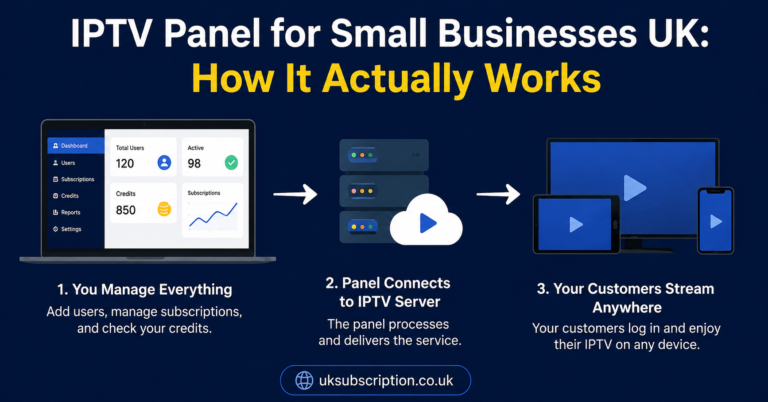
Not deep ones. You don’t manage servers yourself — your supplier does. You need to understand the basics well enough to guide customers through setup and ask suppliers the right questions about uptime and load handling. Most operational skill is communication, not networking.
What’s the biggest mistake new resellers make?
Choosing a supplier purely on credit price. Cheap panels with weak infrastructure collapse under load, trigger mass refunds, and destroy the reputation you spent weeks building. The cost saved on credits is dwarfed by the revenue lost to churn within months.
How do I get my first IPTV customers?
Word of mouth converts best in this market. Offer a genuine free trial, deliver a flawless first experience, and ask happy customers to refer others. Paid advertising works too, but referrals from customers who’ve never had a bad streaming night are both cheaper and far stickier.
What’s the difference between a reseller and a sub-reseller?
A reseller buys credits directly from a provider and sells to end customers. A sub-reseller buys from another UK IPTV reseller, sitting one layer further down the chain. Sub-reselling has a lower entry point but thinner margins and more dependency on the reliability of the reseller above you.
Why do customers leave IPTV services?
Rarely over price. The top reasons are buffering during important live events, slow or missing support, and confusing setup that frustrates them before they ever get watching. Fix reliability and response time and you’ll keep the overwhelming majority of customers you acquire.
Can I run an IPTV reseller business part-time?
At small scale, yes. But understand that support response time is your competitive edge, and customers have problems at unpredictable hours — including during evening and weekend sporting events. Many successful operators start part-time, then commit fully once volume proves the model works.
Success Checklists
For new resellers starting out:
- Source from a direct provider or first-tier reseller, never the cheapest unknown panel
- Test the supplier’s support response time yourself before committing
- Price slightly above market bottom; invest the margin into support
- Build setup templates for the top UK devices before you onboard anyone
- Track your own response time as a core metric from day one
- Start with a manageable credit batch, prove your model, then scale
For established resellers scaling up:
- Audit your churn monthly — find which week customers tend to leave and why
- Pre-empt big sporting events: confirm your supplier’s load handling in advance
- Move repetitive support to templates without losing the human touch
- Build a referral incentive — your renewed customers are your cheapest growth
- Diversify so no single server failure can take out your whole base
For sub-resellers:
- Demand the same support speed from your upstream that you give downstream
- Don’t oversell connections you can’t reliably support
- Keep your own customer list independent of any single panel
- Reinvest early profits into reliability, not just volume
The honest truth about choosing to start your own IPTV business in the UK is that the opportunity is real but unforgiving — it rewards operators who treat reliability and support as the product, and quietly removes the ones who don’t. Get the infrastructure right, answer your customers fast, and this becomes a business that compounds. Get it wrong, and no amount of marketing will save it.